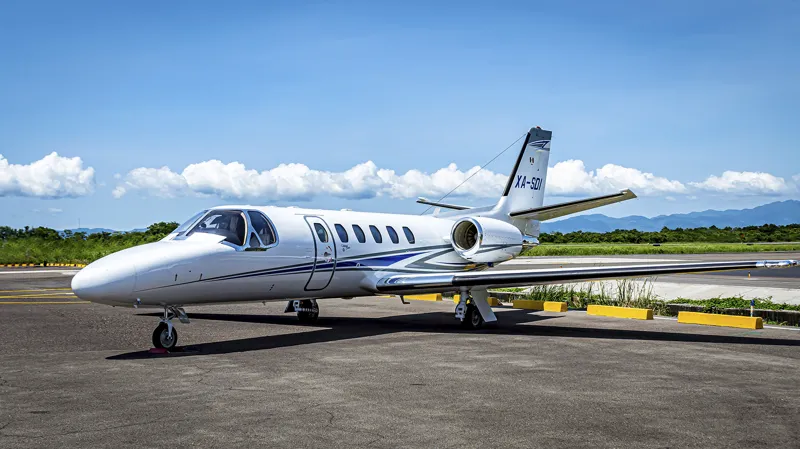
Cessna Citation Bravo Aircraft in Mexico

Mexican-registered aircraft (XA-, XB-, XC- prefixes) operate under DGAC Mexico certification. Cross-border with US is common; import process requires FAA airworthiness verification. Major GA hubs in Mexico City, Toluca, Monterrey, Guadalajara.

← Cessna Citation II family

The Cessna Citation Bravo is a light business jet produced from 1997 to 2006, building on the proven Citation II/IISP airframe with upgraded Pratt & Whitney Canada PW530A engines and a Honeywell Primus 1000 avionics suite. Seating up to 8 passengers, the Bravo cruises at 370 knots with a range of 1,680 nautical miles, making it well-suited for regional business travel across North America.

With a maximum takeoff weight of 14,800 lbs, the Citation Bravo operates efficiently from shorter runways that larger jets cannot access, a hallmark advantage of the Citation line. Fuel burn averages around 130 gallons per hour, and variable operating costs run approximately ,900 per flight hour with annual fixed costs near 00,000.

The Citation Bravo is a popular entry point into jet ownership for small business owners, partnerships, and owner-pilots transitioning from turboprops. Its straightforward systems, two-crew type certification, and relatively modest operating costs make it one of the most accessible light jets on the used market. The type benefits from Cessna's extensive service network and a large parts supply chain, keeping maintenance predictable and manageable.
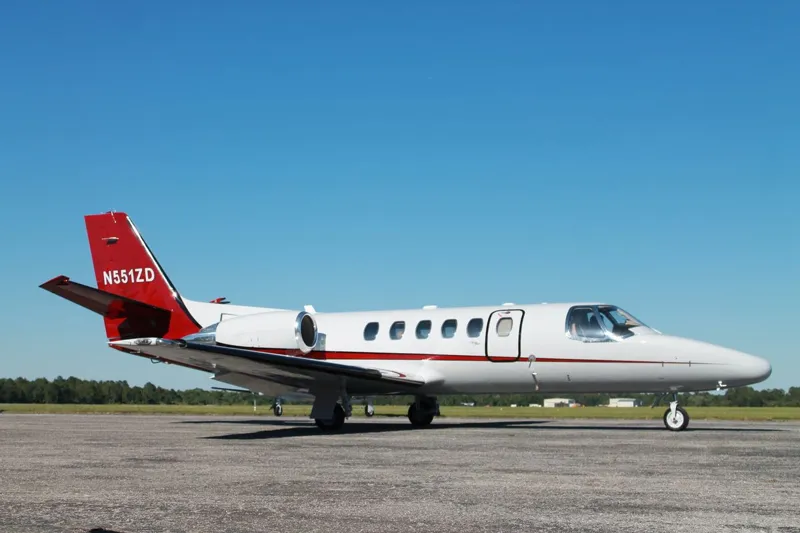
Cessna Citation Bravo aircraft for sale

3 used Cessna Citation Bravo aircraft for sale in Mexico · 8-seat · $550,000–$2,750,000 · market reference $1,600,000 · updated 11 hours ago

Cessna Citation Bravo Specifications

Model spec

The Cessna Citation Bravo is a 8-seat light jet with a cruise speed of 345–404 kt (639–748 km/h), a range of 1,600–2,000 nm (2,963–3,704 km), and a useful load of 3,850–5,200 lbs (1,746–2,359 kg).

Performance
Cruise345–404 kt (639–748 km/h)
Max Speed375–420 kt (694–778 km/h)
Range1,600–2,000 nm (2,963–3,704 km)
Service Ceiling43,000–45,000 ft (13,106–13,716 m)
Engine & Fuel
EnginePRATT & WHITNEY PW530A
Fuel Capacity387.0–470.0 gal (1,465–1,779 L)
Fuel Burn125.0–135.0 GPH (473–511 L/h)
TBO4,500 hrs
ICAO TypeC55B
Weights & Seats
Seats8–10
Max Gross Weight13,300–15,100 lbs (6,033–6,849 kg)
Useful Load3,850–5,200 lbs (1,746–2,359 kg)
Production1997–2006

Cessna Citation Bravo for Sale

Cessna Citation Bravo asking prices range from $550,000 to $2,750,000, with a median of $2,300,000 (market reference $1,600,000).
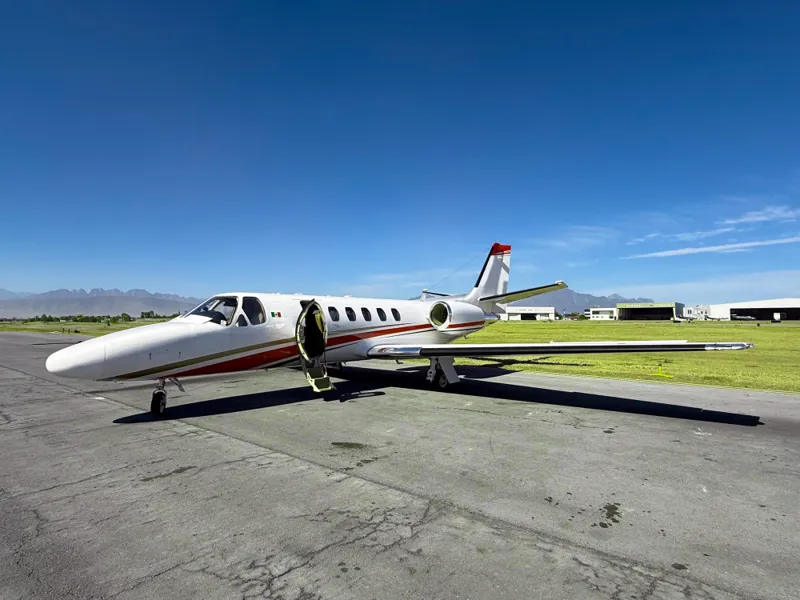
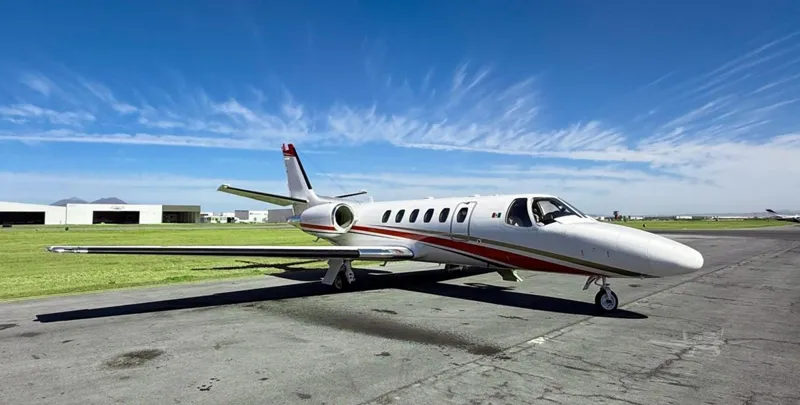
Contact for Price
On Request
Total Time 3,195
Location Toluca, Mexico
Listed 2mo ago
Contact for Price
On Request
Total Time 3,206
Reg# XB-FIR
Location Mexico City, Mexico
Multiple sources
Contact for Price
On Request
Total Time 6,479
Reg# XA-SDI
Location Mexico
Via jetAVIVA

Cessna Citation Bravo Variants

Variant Years Seats Cruise Range Useful load Price range Best for Listings for sale
Citation II 1978–1996 10 345 kts (639 km/h) 1,600 nm (2,963 km) 4,000 lbs (1,814 kg) $349K – $1.1M An early, often single-pilot-certified light jet — among the most affordable ways into Citation jet ownership on the used market. 21
Citation S/II 1985–1997 10 404 kts (748 km/h) 2,000 nm (3,704 km) 5,200 lbs (2,359 kg) Choose the Citation S/II for an improved, straight-wing midsize Citation with better wing performance than the original II. 3

Compare Cessna Citation Bravo

See how the Cessna Citation Bravo stacks up against similar aircraft in specs, price, and operating costs.

Cessna Citation Bravo Price & Cost

How much does a Cessna Citation Bravo cost? Used Citation Bravo prices: $550K – $2.8M, average $2.3M (median $2.3M); market reference $1.6M, across 10 priced of 3 active listings.

Cessna Citation Bravo Price Guide

Key price factors: engine time to overhaul, year and airframe hours, avionics, damage history and logbook completeness — see the buying guide below for the full pre-purchase checklist.

Cessna Citation Bravo Cost of Ownership estimate
Fuel (130.0 GPH × $6.20, 100 hrs)$80,600/yr
Annual Fixed (hangar, insurance, annual)$300,000/yr
Variable (per hour)$1,900/hr
Engine Overhaul (every 4,500 hrs)$280,000
Estimates at 100 flight hours/year. Actual costs vary by usage, location and insurance.

On this Citation the engine maintenance program dominates the budget — hot-section and overhaul time on the Pratt & Whitney / JT15D-class engines, and whether they are enrolled on an hourly program, swing cost far more than purchase price. Add phase inspections, avionics mandates such as ADS-B, insurance and recurrent training; program enrollment and inspections-due decide the real economics, not the headline price.

Buying a Used Cessna Citation Bravo

Buying a Cessna Citation Bravo comes down to a focused pre-purchase checklist — here is what matters most on this model:

What to check before buying

The Citation Bravo (Model 550 Bravo) is the re-engined successor to the Citation II — same 550 fuselage and cabin, but with Pratt & Whitney Canada PW530A engines replacing the older JT15D-4, plus a Honeywell Primus 1000 glass cockpit. Produced from roughly 1997 to 2006, it sits directly above the used Citation II market for buyers who want modern engines and avionics in the familiar 550 package.

Why the PW530A over JT15D-4: The PW530A is a more modern engine than the JT15D-4 — better fuel efficiency and a more contemporary maintenance profile. When comparing a Bravo against a Citation II, the engine generation is the primary reason to pay the premium. The 550 airframe itself is unchanged.

Versus the Citation II: The Bravo and Citation II share the same fuselage — same cabin, same structure. Engine and avionics upgrades are the sole differentiators. For buyers comfortable with the JT15D-4 ecosystem and unconcerned with legacy avionics, the Citation II offers similar utility at lower acquisition cost. The Bravo is the choice when modern engine economics and a glass panel matter.

Crew: The Model 550 Bravo is a two-crew aircraft; the single-pilot 550-series aircraft is the Model 551. Factor crew requirements into ownership planning.

Buy it if: you want the Citation II cabin with meaningfully more modern engines and a glass panel, without stepping into the larger 560 family. The Citation Encore (560) offers a larger cabin with the similarly-modern PW535A; the Bravo delivers comparable mission capability in the smaller 550 package.

Frequently Asked Questions — Cessna Citation Bravo

What is the Citation Bravo?
The Citation Bravo is a Cessna light jet produced 1997–2006, based on the Model 550 airframe that also underpins the earlier Citation II. The defining change from the II was the replacement of the Pratt & Whitney Canada JT15D engines with the newer PW530A — a more efficient engine that improved cruise performance, reduced noise, and updated the aircraft's operating-cost profile. The Bravo carries six to seven passengers and requires a two-pilot crew (not type-certified for single-pilot; single-pilot only under FAA Waiver).
What changed from the Citation II to the Bravo?
The primary change is the engine: the Bravo's PW530A replaced the JT15D found in the Citation II, delivering improved efficiency and performance. Associated with the engine upgrade were avionics improvements and systems refinements. The airframe heritage remains the 550-series, so the cabin dimensions and basic structure are familiar to Citation II operators — the Bravo is an evolution, not a clean-sheet design.
What should I inspect on a pre-owned Citation Bravo?
Focus on PW530A engine health — hot-section inspection records, time since last inspection, and AD compliance. Avionics status matters particularly for ADS-B compliance and any mandate-related work that may or may not have been completed. The 550-series airframe has a well-documented maintenance history; look for corrosion at door frames and attend to the standard Citation pressurization-system inspection requirements.
How fast and how far does the Citation Bravo fly?
The Bravo cruises at approximately 370–400 kt with a range of approximately 1,680–1,800 nm depending on payload and configuration. These figures place it above the early CJ1 in cabin but below the CJ3 and CJ4 in straight-line performance. Actual performance varies by aircraft configuration and avionics weight.
Bravo vs CJ1 or CJ2 — which should I buy?
The Bravo offers a larger cabin than the CJ1 with comparable range; see the dedicated Bravo vs CJ1 comparison page. Against the CJ2, the Bravo's 550-series cabin differs in character from the CitationJet airframe — the decision is legacy heritage versus modern design. The CJ2 is single-pilot certified; the Bravo requires a two-pilot crew (type-certified two-crew, single-pilot only under FAA Waiver).
Is the Citation Bravo still supported?
Yes. Textron Aviation supports the Bravo with parts and maintenance documentation, and the PW530A engine has strong support through Pratt & Whitney Canada's service network. As an aircraft that left production in the mid-2000s, some avionics components may require updating, but the core airframe and engine are not orphaned.

Cessna Citation Bravo Inventory by Country

United States28
Mexico3
United Kingdom1

Cessna Citation Bravo by Price

Under $500k5

Cessna Citation Bravo by Decade

1990s1
2000s2

Cessna Citation Bravo Safety Record

No NTSB events on record for the Cessna Citation Bravo. Individual aircraft safety records may be available on detail pages.

Source: NTSB Aviation Accident Database

Disclaimer: All prices, cost estimates, and market values shown are based on asking prices from third-party sources and are provided for informational purposes only. AeroGurus is not an appraiser, broker, or financial advisor. Always obtain a professional appraisal and independent inspection before making a purchase decision.
Listings last refreshed 11 hours ago · Data: FAA Registry, NTSB · About our data