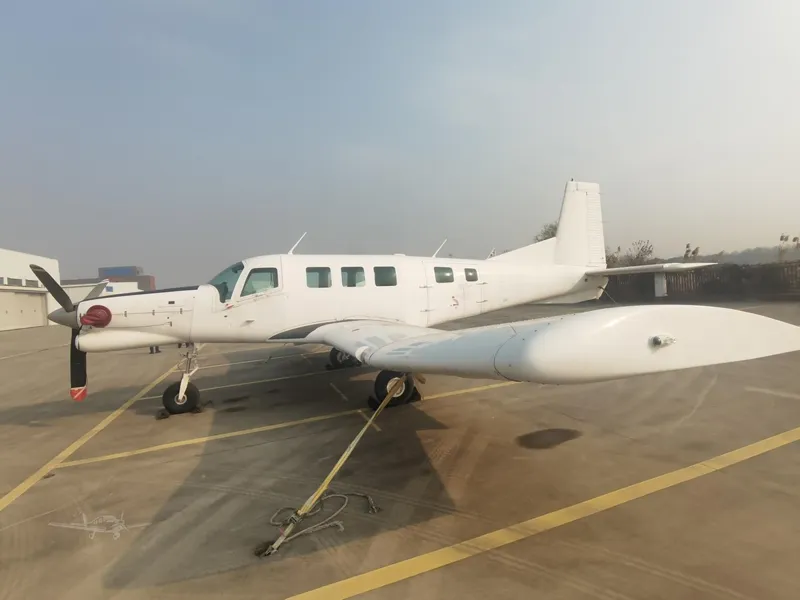
Cessna 208 vs Pacific Aerospace PAC 750XL

The PAC 750XL and Cessna 208 Caravan are single PT6 turboprop utility aircraft — the 750XL a short-field skydive/freight specialist, the Caravan the high-volume utility benchmark.

Live Market Snapshot

Current asking-price market, aggregated across multiple marketplaces · re-checked on a rolling daily cycle

Cessna 208

No active listings right now.

Pacific Aerospace PAC 750XL
For sale now
1
Model years available
2018–2018

Live data from AeroGurus, aggregated daily across the used-aircraft market. Figures are current asking prices, not appraisals — confirm with a pre-buy inspection.

Safety Record

Absolute counts scale with fleet size — the most-produced types log more events without being less safe. Compare the % fatal.

NTSB (1982–now)Cessna 208Pacific Aerospace PAC 750XL
All events332
Serious28
Fatal115
Fatalities392
% Fatal35%

Full Specs Comparison

Swipe to see all specs
Spec / Model Cessna 208 Pacific Aerospace PAC 750XL
Cessna 208
View 26 listings →
Median $2,395,000
Pacific Aerospace PAC 750XL
View 1 listings →
Median $1,000,000
Price Range $1,395,000 – $3,300,000 $1,000,000
Category Single Engine Turboprop Single Engine Piston
Model Specifications
Seats 10 10
Horsepower 675 HP 750 HP
Cruise Speed 170 kts (315 km/h) 140 kts (259 km/h)
Range 1,070 nm (1,982 km) 1,179 nm (2,184 km)
Service Ceiling 25,000 ft (7,620 m) 20,000 ft (6,096 m)
Max Gross Weight 8,000 lbs (3,629 kg) 7,500 lbs (3,402 kg)
Useful Load 3,300 lbs (1,497 kg) 4,000 lbs (1,814 kg)
Fuel Capacity 335.0 gal (1268 L)
Fuel Burn 50.0 GPH (189 L/h) 45.0 GPH (170 L/h)
TBO 3,500 hrs
Overhaul Cost $400,000
Annual Fixed $120,000
Hourly Variable $700
Engines 1 x Turboprop 1 x Turboprop

Cost of Ownership

Estimate

Cessna 208

Fuel$275/hr
Variable$700/hr
Annual Fixed$120,000/yr
Total (200 hrs/yr) $260,000/yr

Pacific Aerospace PAC 750XL

Fuel$248/hr

Which Should You Buy: Cessna 208 or Pacific Aerospace PAC 750XL?

Bottom line: Choose the Caravan for the largest support network, cabin and payload versatility; choose the PAC 750XL for outstanding short-field/skydive performance at lower cost. Caravan = support/payload; 750XL = STOL/skydive/value.

Pick the 208 if…

  • Faster cruise — 170 kts vs 140 kts.
  • More inventory — 26 listings vs 1.

Pick the PAC 750XL if…

  • Budget matters — from $1,000,000 vs $1,395,000, you save ~$395,000.
  • Longer range — 1179 nm vs 1070 nm.

Auto-generated from current market data and published specs. Confirm with a pre-buy inspection and professional appraisal.

Frequently Asked Questions

What's the key difference between the Cessna 208 Caravan and PAC 750XL?
The Cessna 208 Caravan (PT6A-114A, ~675 shp, up to 14 seats, ~185 kt, floatplane-capable) is the global utility turboprop standard — operated by thousands. The PAC 750XL (Pacific Aerospace, New Zealand) uses a PT6A-34 engine, seats up to around 17 in jump configuration, and is designed specifically for skydiving and utility operations, with a large rear door and strong climb. The PAC 750XL is a niche aircraft; the Caravan is universally supported.
Caravan or PAC 750XL — which utility turboprop?
Buy the Caravan if: global support network, floatplane certification, cargo operations, and universal parts availability are priorities. Buy the PAC 750XL if: skydiving operations specifically, or the large rear door and fast-to-altitude climb are operationally required — the PAC is purpose-built for jump operations. Outside jump operations, the Caravan's support advantage is decisive.
What makes the PAC 750XL a jump-plane specialist?
The PAC 750XL was designed with jumpers in mind — a large rear door for exits, fast climb to jump altitude, and a cabin layout optimised for jump runs. It is widely used in skydiving operations that find the Caravan's climb rate or door size limiting.
How do specs compare?
Cessna 208B Caravan: PT6A-114A (~675 shp), up to 14 seats, ~185 kt, floatplane-capable. PAC 750XL: PT6A-34 (~750 shp), up to ~17 seats in jump config, ~140–170 kt, large rear door.
Which is cheaper to operate?
The Caravan's massive installed base keeps parts and maintenance costs lower globally. The PAC 750XL's smaller production run means a smaller support network and potentially higher maintenance overhead outside its home market. For jump operations, the PAC's altitude efficiency can offset its support disadvantage.
Which should I buy?
Cessna 208 for general utility, cargo, charter, and float operations — the global standard. PAC 750XL specifically for skydiving operations where its jump-optimised design and large door justify the smaller support network.
Which is better, Cessna 208 or Pacific Aerospace PAC 750XL?
It depends on your mission and budget. The 208 cruises at 170 kts with 1,070 nm range. The PAC 750XL cruises at 140 kts with 1,179 nm range. Review the specs table above to find which fits your flying profile.
How do prices compare?
Pacific Aerospace PAC 750XL: from $1,000,000. Prices vary by year, hours, avionics, and condition. Always get a pre-buy inspection.
What's the difference between Cessna 208 and Pacific Aerospace PAC 750XL?
208 engine: PRATT & WHITNEY PT-6A-114 (675 hp). Cruise: 170 vs 140 kts. Range: 1070 vs 1179 nm.
Which is cheaper to operate per hour?
208: about $700/hr variable cost. Variable cost includes fuel, reserves and overhaul accruals. Annual fixed costs (hangar, insurance, annual inspection) add to the total.
Which has more seats and useful load?
208: 10 seats / 3,300 lb useful load. PAC 750XL: 10 seats / 4,000 lb useful load. Useful load = max gross weight minus empty weight; it determines how much fuel plus payload you can carry.
How does maintenance compare — TBO and overhaul cost?
208: 3,500-hour TBO, overhaul ~$400,000. Reaching the time-between-overhaul (TBO) triggers a mandatory engine/airframe rebuild that affects resale value.
Disclaimer: All prices and cost estimates are from third-party sources for informational purposes only. Always obtain professional appraisal and inspection before purchase.
Prices re-checked on a rolling cycle — most within a few days · Data: FAA Registry, NTSB · About our data