
Dassault Falcon 2000 vs Dassault Falcon 7X
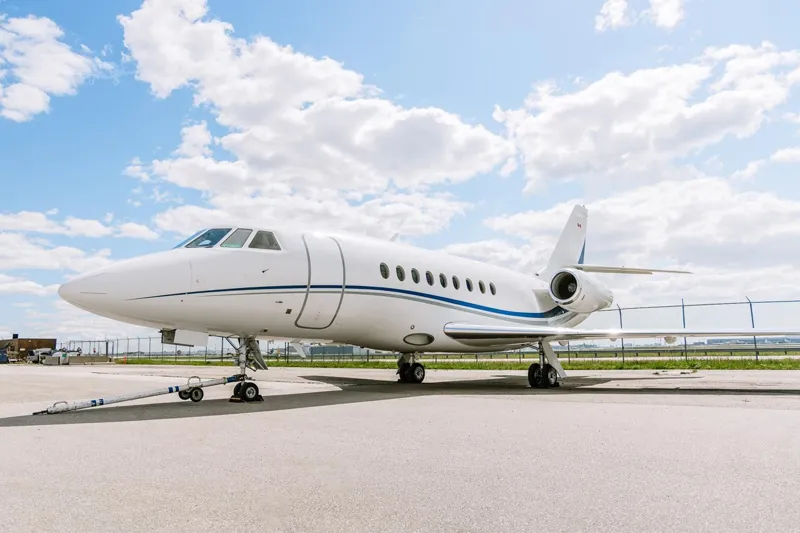
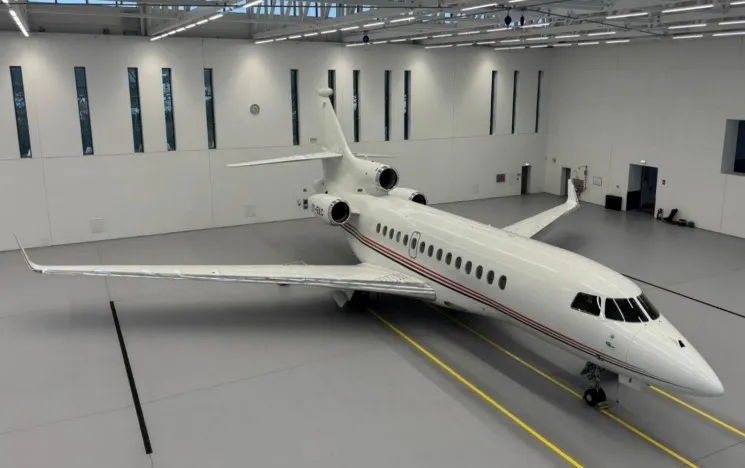
The Dassault Falcon 2000 and the Falcon 7X occupy opposite ends of the Falcon product line — different engine counts, different ranges, and different engineering philosophies that share only the Dassault pedigree and the Falcon name. The Falcon 2000 (1994) brought the Falcon formula to the large-cabin midsize category: a wide, comfortable cabin for eight to ten passengers, twin turbofan engines (original production used CFE738 powerplants; the Falcon 2000EX and later variants standardized on Pratt & Whitney Canada PW308C engines), and transcontinental range without the weight and operating costs of a larger platform. The Falcon 7X (2007) is a trijet — three Pratt & Whitney Canada PW307A engines, a cabin sized for fourteen to sixteen passengers, and a range that covers most nonstop intercontinental missions. The cross-shop occurs for operators evaluating large-cabin Falcons who need to understand what the 7X's third engine and additional range actually cost and deliver.
Live Market Snapshot
Current asking-price market, aggregated across multiple marketplaces · refreshed daily
- For sale now
- 52
- Median asking
- $7,250,000
- Range
- $4,690,000–$23,350,000
- Model years available
- 1995–2021
- For sale now
- 23
- Model years available
- 2007–2020
Live data from AeroGurus, aggregated daily across the used-aircraft market. Figures are current asking prices, not appraisals — confirm with a pre-buy inspection.
Full Specs Comparison
| Spec / Model | Dassault Falcon 2000 | Dassault Falcon 7X |
|---|---|---|
|
|
|
| Price Range | $4,690,000 – $23,350,000 | $7,671,750 – $34,442,500 |
| Category | Large Cabin Jet | Ultra-Long Range Jet |
| Model Specifications | ||
| Seats | 12 | 16 |
| Cruise Speed | 459 kts (850 km/h) | 459 kts (850 km/h) |
| Range | 4,000 nm (7,408 km) | 5,950 nm (11,019 km) |
| Service Ceiling | 47,000 ft (14,326 m) | 51,000 ft (15,545 m) |
| Max Gross Weight | 42,800 lbs (19,414 kg) | 70,000 lbs (31,752 kg) |
| Useful Load | 12,000 lbs (5,443 kg) | 18,000 lbs (8,165 kg) |
| Fuel Capacity | 2,530.0 gal (9576 L) | 4,150.0 gal (15708 L) |
| Fuel Burn | 280.0 GPH (1060 L/h) | 340.0 GPH (1287 L/h) |
| TBO | 5,000 hrs | 6,000 hrs |
| Overhaul Cost | $800,000 | $800,000 |
| Annual Fixed | $500,000 | $800,000 |
| Hourly Variable | $3,800 | $4,500 |
| Engines | 2 x Turbofan | 3 x Turbofan |
Cost of Ownership
EstimateDassault Falcon 2000
Dassault Falcon 7X
Which Should You Buy: Dassault Falcon 2000 or Dassault Falcon 7X?
Bottom line: Choose the Falcon 2000 (EX, EX EASy, LX, or S variants) for twin-engine economics and transcontinental range — the Falcon 2000 series is the most cost-efficient large-cabin Falcon, with operating costs meaningfully below the 7X and range that covers North Atlantic crossings and most Pacific-rim routes from the U.S. West Coast. PW308C-equipped variants (EX and later) are the preferred configuration. Choose the Falcon 7X for intercontinental routing that a twin cannot cover nonstop — the 7X's approximately 5,950 nm range and trijet architecture open direct operations between city pairs the Falcon 2000 routes through a fuel stop. Safety axis: the Falcon 7X's third engine provides an additional layer of redundancy that operators legitimately value for overwater and polar routes — ETOPS regulations apply differently to twin and three-engine jets, and the 7X's trijet certification allows certain route authorizations a twin cannot receive. For operators who fly primarily domestic or North Atlantic routes, this distinction rarely affects operations; for global operators in specific regions, it can be an operational requirement.
Pick the Falcon 2000 if…
- Budget matters — from $4,690,000 vs $7,671,750, you save ~$2,981,750.
- Lower operating cost — ~$3800/hr vs $4500/hr.
Pick the Falcon 7X if…
- More seats — 16 vs 12.
- Longer range — 5950 nm vs 4000 nm.
- Newer design — production from 2007 vs 1995.
- More inventory — 27 listings vs 26.
Auto-generated from current market data and published specs. Confirm with a pre-buy inspection and professional appraisal.