
Beechcraft King Air 350 vs Beechcraft King Air 90
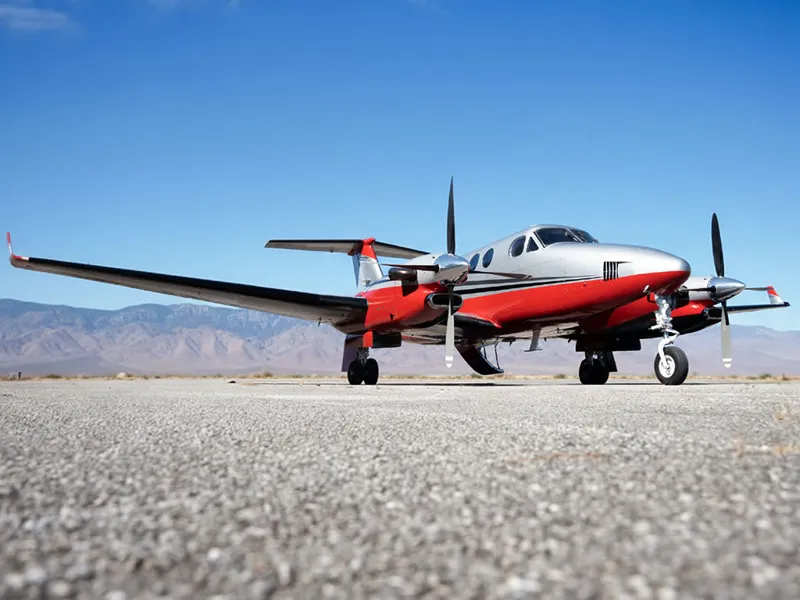
The King Air C90 and the King Air 350 bracket sixty years of Beechcraft turboprop evolution — same DNA, profoundly different aircraft. The C90 series (the most common variant of the 90 family, produced from 1971 onward in progressive upgrades through the C90GTx) established the King Air formula: PT6A turboprops, pressurized cabin, Beechcraft build quality, and the rugged utility that made this aircraft the default choice for regional operators, corporate flight departments, and owner-pilots who needed to move four to six people in pressurized turboprop comfort. The King Air 350 (introduced in 1990 as the Super King Air 350) is the King Air line fully realized: a stretched fuselage, winglets, PT6A-60A engines producing meaningfully more power than the 90 series, and a cabin that approaches regional airliner dimensions. Both wear the King Air name; the cross-shop occurs when a buyer asks where on the King Air spectrum their mission actually belongs.
Live Market Snapshot
Current asking-price market, aggregated across multiple marketplaces · refreshed daily
- For sale now
- 72
- Median asking
- $3,197,500
- Range
- $1,952,250–$5,237,500
- Model years available
- 1990–2019
- For sale now
- 116
- Median asking
- $1,172,500
- Range
- $413,000–$3,117,025
- Model years available
- 1965–2014
Live data from AeroGurus, aggregated daily across the used-aircraft market. Figures are current asking prices, not appraisals — confirm with a pre-buy inspection.
Full Specs Comparison
| Spec / Model | Beechcraft King Air 350 | Beechcraft King Air 90 |
|---|---|---|
|
|
|
| Price Range | $1,952,250 – $5,237,500 | $413,000 – $3,117,025 |
| Category | Multi Engine Turboprop | Multi Engine Turboprop |
| Model Specifications | ||
| Seats | 11 | 10 |
| Horsepower | — | 550 HP |
| Cruise Speed | 295 kts (546 km/h) | 215 kts (398 km/h) |
| Range | 1,806 nm (3,345 km) | 1,060 nm (1,963 km) |
| Service Ceiling | 35,000 ft (10,668 m) | 30,000 ft (9,144 m) |
| Max Gross Weight | 15,000 lbs (6,804 kg) | — |
| Useful Load | 5,400 lbs (2,449 kg) | 2,700 lbs (1,225 kg) |
| Fuel Capacity | 544.0 gal (2059 L) | — |
| Fuel Burn | 120.0 GPH (454 L/h) | 65.0 GPH (246 L/h) |
| TBO | 3,600 hrs | 3,600 hrs |
| Overhaul Cost | $450,000 | — |
| Annual Fixed | $220,000 | — |
| Hourly Variable | $1,100 | — |
| Engines | 2 x Turboprop | 2 x Turboprop |
Cost of Ownership
EstimateBeechcraft King Air 350
Beechcraft King Air 90
Which Should You Buy: Beechcraft King Air 350 or Beechcraft King Air 90?
Bottom line: Choose the King Air C90 for lower acquisition cost, lower operating expense, and an accessible single-pilot-appropriate platform for missions that don't demand the 350's range and capacity. The C90's PT6A-21 or PT6A-135A engines (depending on variant) burn less fuel per hour than the 350's PT6A-60As, and a well-maintained C90B or C90GT is the most accessible entry point to King Air ownership. Choose the King Air 350 when the mission requires the cabin — eight to eleven seats versus the C90's four to six, a flat floor, stand-up headroom for typical adult heights, and the range and climb performance to complete demanding IFR missions above weather with meaningful fuel reserves. Safety axis: the King Air 350 is approved for single-pilot operation in specific avionics configurations, but the step from C90 to 350 involves substantially more complex systems, higher fuel burns, and a weight category that changes the energy management discipline. A pilot transitioning from a C90 to a 350 benefits from formal King Air 350 type training, not just a checkout — the PT6A is forgiving, but the 350's speed and weight demand current proficiency.
Pick the King Air 350 if…
- More seats — 11 vs 10.
- Faster cruise — 295 kts vs 215 kts.
- Longer range — 1806 nm vs 1060 nm.
- Newer design — production from 1990 vs 1966.
- More inventory — 50 listings vs 7.
Pick the King Air 90 if…
- Budget matters — from $413,000 vs $1,952,250, you save ~$1,539,250.
Auto-generated from current market data and published specs. Confirm with a pre-buy inspection and professional appraisal.